Sustainability & Environmental Commitment

FrostLine Industrial is engineering a lower-carbon future for ice production and refrigeration — through ENERGY STAR certification, natural refrigerant adoption, water conservation, and lifecycle-conscious product design.

Refrigerant Transition Roadmap

The global phase-down of high-GWP HFCs under the Kigali Amendment and EU F-Gas Regulation is reshaping the refrigeration industry. FrostLine is proactively transitioning to natural and low-GWP alternatives across our entire product portfolio.

2020 First R-290 (propane) ice machine models launched — GWP of 3 vs. R-404A’s GWP of 3,922
2024 50% of new ice machine production ships with refrigerants below GWP 150
2026 R-744 (CO2) cascade systems introduced for industrial ice plants above 20 tons/day
2028 Target: 100% of new production below GWP 150 — ahead of most regulatory deadlines
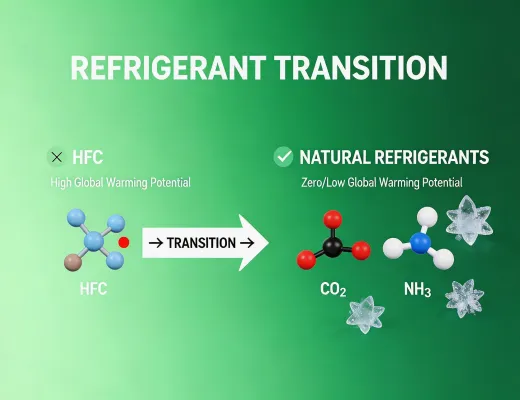
FrostLine refrigerant transition roadmap from HFC to natural refrigerants

Energy Efficiency Achievements

Ice production is energy-intensive. We engineer every component to minimize kWh per ton of ice produced.

85%

ENERGY STAR Certified

85% of our ice machine models carry ENERGY STAR certification, consuming 15–30% less energy than federal minimum efficiency standards require.

30%

Energy Reduction

Variable-speed compressor technology across our cold storage range delivers up to 30% energy savings at part-load conditions compared to fixed-speed alternatives.

EC

EC Fan Motors

Electronically commutated fan motors on all condenser and evaporator units reduce fan energy consumption by 40–70% versus conventional AC motors.

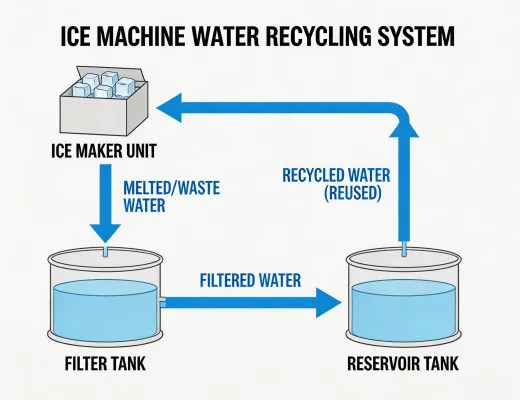
FrostLine water conservation and recycling system

Water Conservation

Ice machines consume significant water — both for ice production and for cooling (in water-cooled models). FrostLine is committed to reducing water waste across every product line.

  • Closed-loop condenser water systems — recirculate cooling water to reduce consumption by up to 95% versus once-through designs
  • Harvest water recycling — unfrozen water from the ice-making cycle is recaptured and reused, cutting freshwater intake by 15–20%
  • Smart purge cycles — mineral concentration sensors trigger purge only when scale risk is detected, eliminating fixed-interval water waste
  • Air-cooled model prioritization — expanding air-cooled options across the lineup to eliminate cooling water entirely where feasible

Lifecycle-Conscious Design

We design for durability first — because the most sustainable equipment is the equipment that doesn’t need replacing.

15+ Year average service life
92% Recyclable materials by weight
100% Refrigerant recovery at end-of-life
10 yr Spare parts availability guarantee

Compressor Technology: Variable Speed vs. Fixed Speed

Energy savings claims require context. The economic case for inverter-driven compressors depends on the application’s load profile, local electricity rates, and equipment lifecycle.

Variable Speed (Inverter) Compressors

Inverter compressors modulate capacity from 25% to 100% of rated output, matching ice production or cooling load in real time. In variable-load applications such as cold storage warehouses with fluctuating inventory, measured energy savings range from 30% to 50% at part-load conditions (IPLV basis) compared to fixed-speed units cycling on/off.

Trade-off: Inverter compressors cost 25–40% more than fixed-speed equivalents, add electronic drive boards susceptible to voltage spikes, and require technicians trained in VFD diagnostics. Payback periods range from 2.5 to 5 years depending on utilization and electricity cost (breakeven at approximately $0.12/kWh for a 500 kg/day ice machine running 16 hours/day).

Fixed Speed Compressors

Fixed-speed compressors deliver rated capacity at full output and cycle off when the setpoint is reached. In constant-load applications — such as dedicated ice production lines running at 90%+ capacity during production shifts — fixed-speed compressors match inverter efficiency within 5–8% while offering lower capital cost, simpler controls, and higher mean time between failures (MTBF).

Trade-off: On/off cycling causes temperature fluctuations of ±2–3°C in storage chambers (vs. ±0.5°C with inverter control), higher inrush current at each startup, and faster wear on contactors and motor windings. Not recommended for pharmaceutical cold storage or precision temperature applications.

FrostLine offers both compressor types across the product range. Our application engineers model the expected load profile and calculate projected energy cost, maintenance cost, and total cost of ownership (TCO) over a 15-year equipment lifecycle before recommending a compressor platform.

Sustainability Scope & Boundaries

Refrigerant Transition Constraints

Our 2028 low-GWP target applies to new production units only. Existing installed equipment using R-404A or R-134a will continue to require virgin or reclaimed HFC refrigerant for servicing until decommissioned. Retrofit of existing systems to natural refrigerants is technically feasible but typically costs 60–80% of new equipment price, making replacement more economical in most cases.

Energy Certifications Geographic Scope

ENERGY STAR certification applies to U.S. and Canadian markets only. Equipment exported to other regions meets local efficiency standards (EU EcoDesign, Australian GEMS) but may not carry ENERGY STAR labeling. The 85% certification rate refers to our North American ice machine catalog.

Water Savings Baseline

The 95% water reduction figure for closed-loop condenser systems is measured against once-through water-cooled designs at standard AHRI 810 test conditions. Actual water savings vary with inlet water temperature, ambient conditions, and the type of cooling tower employed. Air-cooled models eliminate condenser water entirely but may consume 10–15% more electricity than water-cooled equivalents.

Partner With Us on Your Sustainability Goals

Our engineering team can calculate the energy, water, and carbon savings of upgrading to FrostLine equipment. Request a lifecycle cost analysis for your operation.

Request Lifecycle Analysis